About the Founder
I spent years guessing. Metriq is what I wish I had from the start.
I'm Omar, the person who built Metriq Body.
At my heaviest, I was around 270 lbs. Today I'm at 197.
But Metriq didn't take me from 270 to 197.
I built it after spending years figuring out fat loss, nutrition, and training the hard way. I started using an early version myself at around 225 lbs.
What changed wasn't some secret diet or workout.
I stopped guessing.
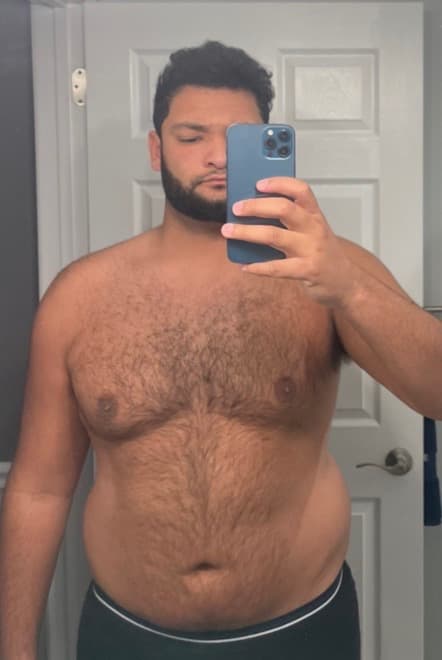

Around 270 lbs in late 2021 → 197 lbs today. Metriq entered the picture during the later stage, around 225 lbs. (Individual result — not typical; provided as founder background, not a guarantee of outcomes.)
I wasn't always out of shape
Growing up, sports were a huge part of my life.
I played football and baseball in high school, trained year-round, and went into college around 225 lbs and athletic. That was where I originally learned how to lift.
Then I got to college and pretty much majored in partying.
I stopped training. I drank a lot. I ate whatever was in front of me.
After college, I moved to New York and carried most of those habits into working life. I wasn't exercising, my sleep was terrible, work was stressful, and going out two or three nights a week wasn't unusual.
By the end of 2021, I was 270 lbs.
And for a long time I didn't really confront it.
Then one day the jokes stopped being funny
During the summer of 2021, I was at some pool parties with friends I've known most of my life.
They made some of the same jokes they'd made before about me getting fat.
For whatever reason, that time it landed differently.
I remember looking at myself and thinking:
“Damn. Yeah, I am fat.”
A few of my friends weren't particularly happy with where they were physically either, so at the beginning of 2022 we turned it into a group challenge.
And looking back, the most important part wasn't some perfect diet.
It was accountability.
We lived close to each other. We went to the gym together. Instead of automatically going to a bar on the weekend, we'd stay at someone's house. We'd grocery shop together, send pictures of meals in the group chat, and talk about what we were eating.
For four or five months, fitness basically became something we were doing together.
I dropped 35 lbs, getting down to 235.
And then I stayed there for years
Once summer came around, I stopped pushing the weight loss.
And honestly, I was fine with that.
For the next few years I stayed around 235. I looked better. I felt better. I wasn't the guy at 270 anymore.
But I also wasn't particularly analytical about any of it.
I didn't know exactly how many calories I should eat.
I didn't know exactly how much protein I needed.
I didn't have a system telling me when something should change.
Most of what I was doing came from things I'd learned growing up, things I saw online, and what seemed to be working.
There was always a little question in the back of my head:
Is this actually right, or am I just hoping consistency eventually gets me there?
2026 was different
By 2026, motivation had dipped and things had drifted for a while.
At first, my goal was simple: get back to where I'd been.
Then something changed.
Instead of just wanting to lose a few pounds, I wanted to find out what I could actually do with my body.
So I got much more serious.
I started lifting six days a week.
I was consistently moving enough to hit roughly 8,000–12,000 steps a day.
My calories generally landed around 2,300–2,700 per day.
I consistently ate 200+ grams of protein.
I stopped forcing myself into the idea that I needed three traditional meals every day. Two substantial meals worked better for me.
And I cut alcohol out completely.
The biggest difference wasn't that I discovered some magical new exercise.
I became extremely consistent.
The scale stopped being the goal
I also stopped obsessing over what I weighed.
I barely weigh myself now.
Because if somebody told me tomorrow that I weighed 225 lbs but I had more muscle and less body fat, I wouldn't care that the number was higher.
That's not what I'm chasing.
I didn't want to lose a bunch of weight and become a smaller version of myself.
I wanted to lose fat while keeping — and ideally building — muscle.
I wanted my lifts to keep progressing.
I wanted definition.
I wanted to still look like a bigger guy, just a significantly leaner and stronger one.
So instead of constantly chasing a number on a scale, I started paying much more attention to:
- how I looked
- how my clothes fit
- my gym performance
- whether my lifts were progressing
- whether I was actually sticking to what I said I would do
That's still how I think about progress.
The problem was that everything lived in my head
Even when I became disciplined, there was still one problem.
I was managing everything myself.
Calories. Protein. Meals. Training. Progress. What to adjust. Whether I should eat less. Whether I should do more cardio. Whether I was actually stalled or simply being impatient.
I used MyFitnessPal for a while because it helped me understand how many calories were actually in the food I was eating.
But that was basically where it stopped.
Knowing that I ate 2,500 calories doesn't answer: should I have eaten 2,500 calories?
It doesn't tell me how much protein to hit, what to lift today, whether anything should change this week, or whether I'm actually doing enough.
I wanted all of those decisions connected.
That's where Metriq came from.
I started using Metriq around 225 lbs
This part matters because I don't want to rewrite history.
Metriq did not take me from 270 lbs to 197 lbs.
Most of that journey had already started before Metriq existed.
I began using an early version when I was around 225 lbs.
What it changed was the uncertainty.
Instead of constantly deciding what I felt like doing, I knew what I needed to hit across nutrition, meals, protein, and training.
I stopped negotiating with myself.
There were even times when the answer wasn't “eat less.”
Metriq had me eating more protein or more carbohydrates because the objective wasn't simply to starve weight off as quickly as possible.
I wanted to keep training hard.
I wanted to maintain performance.
I wanted to keep muscle while getting leaner.
And I learned to stop treating carbohydrates like something that automatically needed to disappear just because I was losing fat.
Today I'm at 197 lbs— the first time I've been under 200 since I was a sophomore in high school.
What I learned
Progress is not linear.
There were plenty of periods where I seemed to gain weight or stall even though I hadn't changed anything.
Then suddenly I'd drop below where I had been before the spike.
Your body doesn't give you a perfectly smooth chart just because you're following the plan.
Reacting emotionally to every fluctuation is a great way to constantly change something that may already be working.
Consistency beats constantly searching for a better plan.
For years I consumed random fitness advice and wondered whether I should try something different.
The biggest changes happened when I stopped bouncing around and became boringly consistent.
Losing weight and building the body you want aren't always the same goal.
I could have simply tried to make the number on the scale as small as possible.
That wasn't what I wanted.
I wanted less fat and more visible muscle.
Those priorities affect how I eat and how I train.
Accountability matters more than people admit.
My first major weight loss happened with my closest friends literally keeping each other accountable every day.
Once I understood how powerful that structure was, it became obvious to me that relying entirely on motivation isn't a great system.
Metriq is partly my attempt to give people structure even when nobody is standing next to them telling them what to do.
The unglamorous part
Most of this isn't complicated.
It's just difficult to repeat for long enough.
One of my biggest problems used to be eating out and having periods where one bad meal turned into an entire bad day or weekend.
My relationship with food is completely different now.
I'd rather eat at home before going out.
And if I'm out somewhere and genuinely hungry, I'll find something simple rather than turn it into an excuse to blow everything up.
I've legitimately stopped at gas stations for hard-boiled eggs.
That's not a fitness hack.
It's just what consistency eventually looks like.
You stop needing every decision to be exciting.
Why I built Metriq Body
I built Metriq because I think a lot of people are in the exact position I was in.
They don't need another article telling them to “eat healthy and exercise.”
They already know that.
They need to know how much to actually eat, how much protein to actually get, what they're training today, what should change when progress stops — and whether they're still on track.
And they need those answers to work together.
Metriq is the system I wish I'd had when I first looked in the mirror at 270 lbs and realized I needed to change something.
Not because it would have done the work for me.
It wouldn't have.
But it would have removed a hell of a lot of guessing.
What Metriq is — and isn't
I'm not a physician or registered dietitian.
I'm a founder, an experienced lifter, and someone who personally went through a major fat-loss and body-recomposition journey.
Metriq is built around the training and nutrition principles I wanted organized into one system, along with evidence-based guidance and the experience of actually applying these ideas over years.
It is not a substitute for medical care.
For anyone dealing with a medical condition, taking prescription medication, or needing individualized clinical nutrition advice, that belongs with an appropriate healthcare professional.
Where I am now
270 lbs → 235 → 197 lbs
But I'm much less interested in that final number than I would have been a few years ago.
I'm interested in getting stronger.
I'm interested in maintaining muscle.
I'm interested in seeing what I can continue doing with my body.
And I'm still using the same system I'm building for everyone else.
Metriq isn't based on the idea that I've somehow finished.
It's based on the opposite.
You measure. You learn. You adjust. Then you keep going.
If any of this sounds familiar, the method is laid out in the open.
See how Metriq Body works →