Guides & Articles
How to Lose Weight on GLP-1 Medications Without Losing Muscle
Omar · August 21, 2026 · Updated September 7, 2026
When you start a GLP-1 medication, the goal usually feels simple: watch the number on the scale go down. But the scale doesn't tell you what's actually leaving your body. For some people, part of that weight loss can come from lean mass, which includes muscle and other non-fat tissue. You can end up smaller without ending up stronger, and that's a problem I've thought about closely, on my own transformation and every one since.
Why the scale can be misleading on a GLP-1
GLP-1 medications suppress appetite and slow digestion. That's the mechanism that makes them work — and it's also what makes muscle loss more likely. Eating less overall usually means eating less protein, even without deciding to. And a body in a steep calorie deficit will break down muscle tissue for energy if it isn't getting a strong enough protein signal and a reason to keep it.
How much muscle do people actually lose?
More than most people expect, and less predictably than headlines suggest.
Body-composition data from GLP-1 trials is genuinely mixed. In the STEP-1 trial — the landmark semaglutide study — roughly 38–39% of total weight lost showed up as lean mass on body scans. Other meta-analyses put the average closer to 25–31%. Some studies report as low as 15%, others as high as 40–60%, depending on the drug, the dose, and — critically — what the person was doing besides taking the medication.
One important caveat: lean mass on a body scan is not the same thing as pure muscle. It includes water, glycogen, organs, and connective tissue alongside actual skeletal muscle, and it fluctuates for reasons that have nothing to do with strength. A high lean-mass-loss number looks alarming; it isn't automatically a muscle-loss number.
What the range does confirm: lean mass loss on a GLP-1 isn't fixed. It moves with how much protein you're eating and whether you're doing any resistance training while the weight comes off. That's the part actually in your control.
Can you build muscle while taking a GLP-1?
Sometimes — it depends on where you're starting from.
If you're new to resistance training, or coming out of a long stretch of inactivity or a higher body-fat percentage, you can often build real muscle even while eating in a deficit. This is sometimes called body recomposition, and it's common in beginners regardless of what's driving the weight loss.
If you've trained seriously for years, building new muscle in a deficit is much harder — your realistic goal shifts from "build" to "preserve." Either way, the levers are the same: enough protein, and resistance training that progressively challenges the muscle you have.
Why resistance training matters here
Cardio has real benefits, but resistance training is the primary signal your body receives to maintain muscle during weight loss — it's what tells your body "keep this tissue," while a calorie deficit alone tells it "you don't need all of this." Two to three sessions a week, hitting the major muscle groups, is the difference between the scale going down and the scale going down while you stay strong.
What should you track besides the scale?
If the scale is the only number you're watching, you're missing most of the picture. A few things worth tracking alongside it:
- Body weight trend — the direction over 1–2 weeks, not any single day
- Waist measurement — a simple proxy for fat loss that the scale alone can't give you
- Strength numbers — whether your lifts are holding steady or slipping tells you if muscle is being preserved
- Protein consistency — hitting your target most days matters more than hitting it perfectly once
- Energy and recovery — feeling wrecked most of the time is a sign something in the plan needs adjusting
The scale tells you one number. These tell you what that number is actually made of.
A simple GLP-1 muscle-preservation checklist
- Protein target: a daily floor that doesn't move even as your calories drop — not an average you hit "when you remember"
- Resistance training: 2–3 sessions per week, major muscle groups
- Weigh-ins: track the trend, not the daily number
- Targets: re-check protein and calories as your weight changes — a plan set on day one is wrong by week eight
If you don't have that protein floor yet, the free GLP-1 protein calculator computes your protein band and calorie target from your own numbers — the same deterministic math Metriq's engine uses, no account needed.
Why I care about this
My own transformation wasn't on a GLP-1 — mine came from nutrition and training, tracked closely enough to watch the numbers move directly: skeletal muscle starting around 63 lbs and finishing at a scanned 93.5, body fat from roughly 31.5% down to a scanned 17.5%. It taught me the exact lesson this article is about — losing weight and improving your body are two different goals, and chasing the first one blindly can cost you the second. (Individual result — not typical; provided as founder background, not a guarantee of outcomes.)
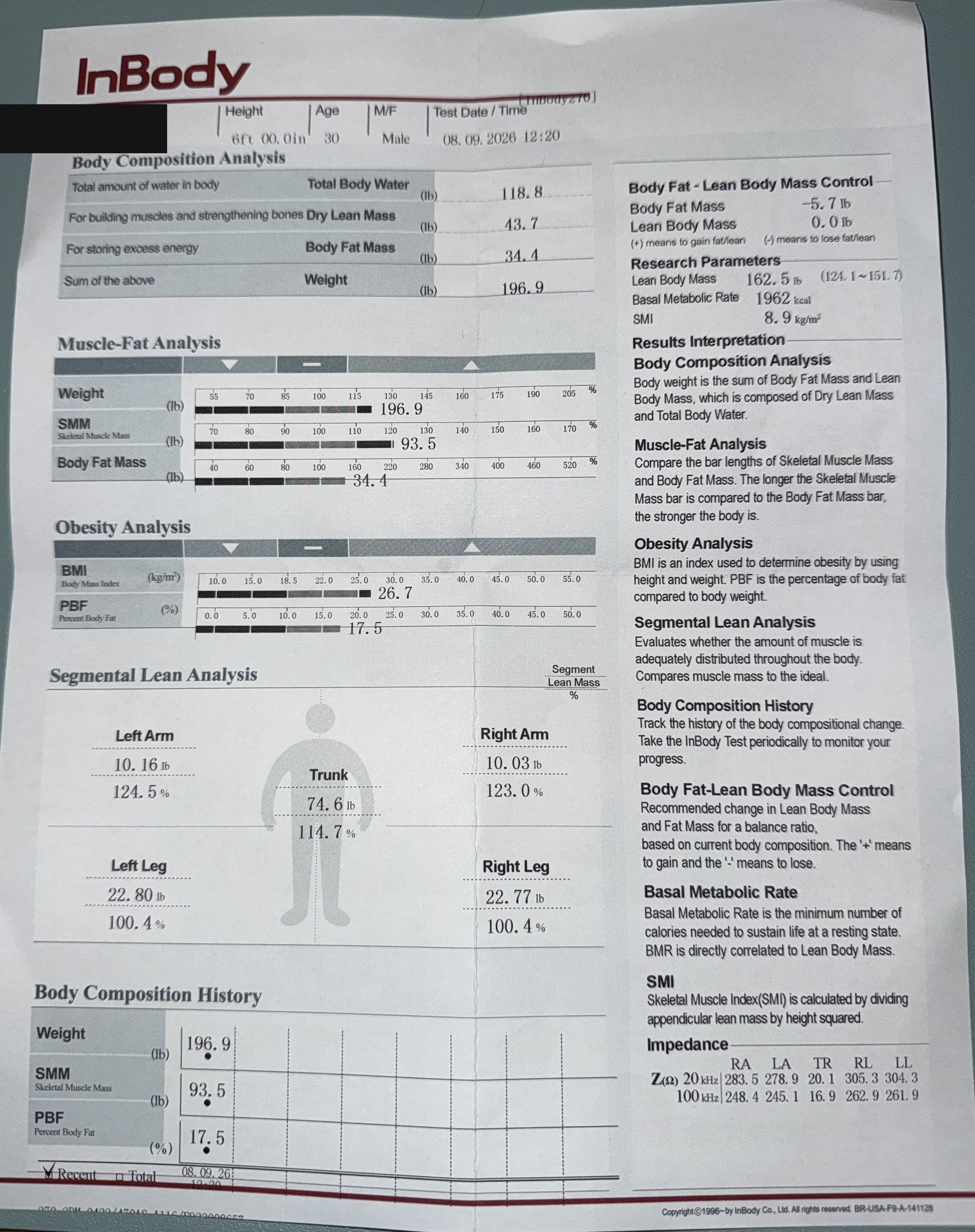
That's the problem Metriq's engine was built to solve for people doing it the slow way, and it applies just as much — arguably more — to weight loss that's happening fast, on a medication, without a plan for what you're keeping. See how it works →
For many people starting a GLP-1, another calorie tracker isn't the missing piece. The missing piece is knowing what numbers actually matter, and having them adjust automatically as your body changes instead of a plan you set once and outgrow. See My Numbers →
Frequently asked questions
Do you lose muscle on Ozempic, Wegovy, Mounjaro, or Zepbound?
Some, for some people — research puts lean mass loss (not pure muscle) at roughly 15–40% of total weight lost, varying by study and drug. It's not inevitable at that scale: adequate protein and resistance training measurably reduce how much of the loss comes from muscle rather than fat.
Can I build muscle while losing weight on a GLP-1?
If you're a beginner or coming out of inactivity, often yes — this is a common form of body recomposition. If you're already well-trained, the more realistic goal is preserving the muscle you have rather than building new muscle in a deficit.
How much protein should I eat while on a GLP-1?
There's no single right number. Many people benefit from aiming for roughly 0.7–1 gram of protein per pound of goal body weight, but the right target depends on your current body composition, activity level, and goals — especially given that GLP-1 users often start from a higher body weight and a lower appetite than a typical "weight loss" reader.
Do I need to lift weights while taking a GLP-1?
If keeping your strength and shape matters as much as the number on the scale — yes. Resistance training is the specific input that preserves muscle during rapid weight loss; cardio alone doesn't provide the same signal.
This article is educational and general in nature — it isn't personalized medical advice. Talk to the doctor managing your prescription about your specific plan.
Related: How to Lose Fat Without Losing Muscle · How Much Protein Do You Need to Lose Weight? · Back to the blog
Sources
- STEP-1 trial data via Barbell Medicine's evidence review: barbellmedicine.com (glp-1-muscle-loss)
- Meta-analysis (Obesity journal) via Healio: healio.com (lean mass share of GLP-1 loss)
- Range + lean-mass-vs-muscle nuance via Medscape: medscape.com (GLP-1s and muscle)